Art Deco is characterized by streamlining and focuses on aerodynamic concepts of motion and speed (Victoria and Albert Museum). The 'Art Deco Wooden Cigarette Box' found on Trade-Me, however, does not embrace these features of the style, and thus is not Art Deco as the seller claims.
Firstly, while it does have smooth round corners, the box in a whole is heavy and angular. This differs from an Art Deco design, which focuses on the idea of velocity, with fluid shapes to represent motion and speed (Victoria and Albert Museum).
Secondly, while at first glace, the pattern across the lid seems to match the abstract theme present in Art Deco, the style of abstraction reminds one of the Design Reform era, more specifically Owen Jones' idea of abstraction: “..conventional representations founded upon them sufficiently suggestive to convey the intended image to the mind..” (Jones, 1956). The abstracted flattened pattern thus suggests an influence from the design reform era.
Lastly, the wooden surface is different from the chrome and shiny reflective surfaces that were most prevalent during Art Deco. Throughout the interior and exterior of the box, the wood is exposed. In this case, truthfulness to the material used is in line with the ideals of the Arts and Craft movement (Ruskin, 1853).
In conclusion, the box should more accurately be classified as a piece influenced by the Design Reform era.
References
Art Deco in America. Retrived from http://www.vam.ac.uk/content/articles/a/art-deco-in-america/
Jones, O. (1856). Grammar of Ornament. Retrived from http://schoolofdesign.ac.nz/pluginfile.php/8443/mod_resource/content/2/wk_4_Design%20Reform_Ruskin.pdf
Ruskin, J. (1853). The Nature of Gothic. Retrived from http://schoolofdesign.ac.nz/pluginfile.php/8443/mod_resource/content/2/wk_4_Design%20Reform_Ruskin.pdf
Labels: dsdn171


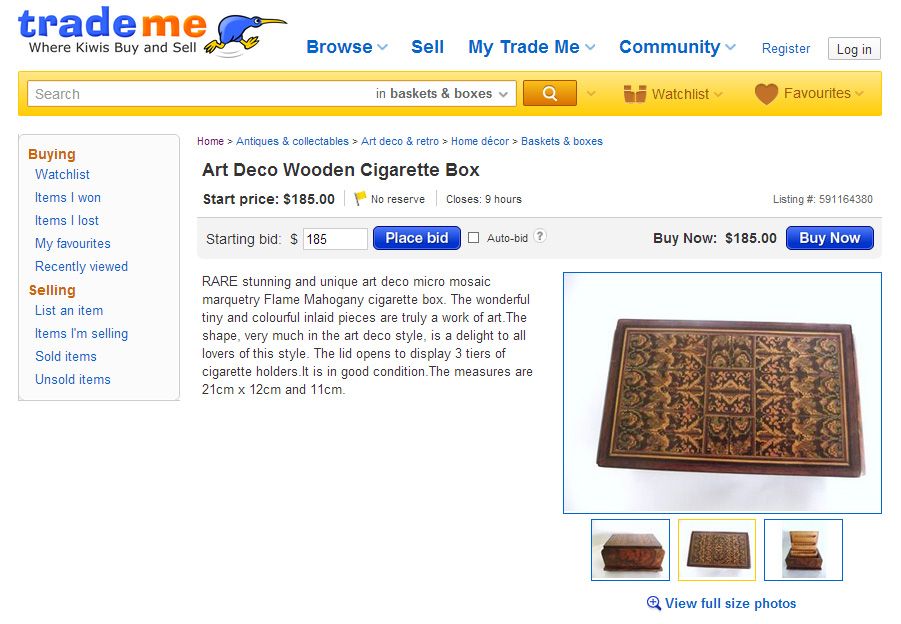
I have always been interested in the Art Deco style, its streamline abstracted design relates closely to my design approach. A search of the words "Art Deco" in Trademe resulted in almost 10,000 hits, and that was in the Antiques and Collectibles section alone. This makes one question the accuracy of the sellers' claims. Is it truly Art Deco, or merely a means to trick unsuspecting buyers into paying more than they should?
This 'Art Deco Wooden Cigarette Box' caught my attention, mainly because it did not resemble the idea of Art Deco I have in mind. Firstly, while it does have instances of smooth round corners, the box in a whole felt heavy and angular. This differs to what one would expect from an Art Deco design, which focuses on the idea of velocity, with fluid shapes to represent motion and speed.
Secondly, at first glace, the pattern spanning across the lid of the box seems to run in line with the abstract theme present in Art Deco. However, the style of abstraction reminds me more of the Design Reform era and Owen Jones' words came to mind: “..natural objects should not be used as ornaments, but conventional representations founded upon them sufficiently suggestive to convey the intended image to the mind..” The abstracted flattened pattern suggests an influence from the design reform era, even more when we look at the warm colour palette which suggest an Arabic influence in which Jones himself derived much of his inspiration with abstraction.
Lastly, the exposed wood material is different from what one would expect from the Art Deco era where chrome and shiny reflective surfaces were most prevalent. Throughout the interior and exterior of the box, the wood is never covered. In this case, truthfulness to the material used is in line with the ideals of the Arts and Craft movement.
Personally, I would disagree with the seller and consider the box of be of the Design Reform era instead.
References
Jones, O. (1856). Grammar of Ornament. Retrived from http://schoolofdesign.ac.nz/pluginfile.php/8443/mod_resource/content/2/wk_4_Design%20Reform_Ruskin.pdf
Ruskin, J. (1853). The Nature of Gothic. Retrived from http://schoolofdesign.ac.nz/pluginfile.php/8443/mod_resource/content/2/wk_4_Design%20Reform_Ruskin.pdf
Images
[Art Deco Wooden Cigarette Box]. (2013). Retrived May 14, 2013, from
http://www.trademe.co.nz/antiques-collectables/art-deco-retro/home-d%C3%A9cor/baskets-boxes/auction-591164380.htm
Labels: dsdn171
Text:
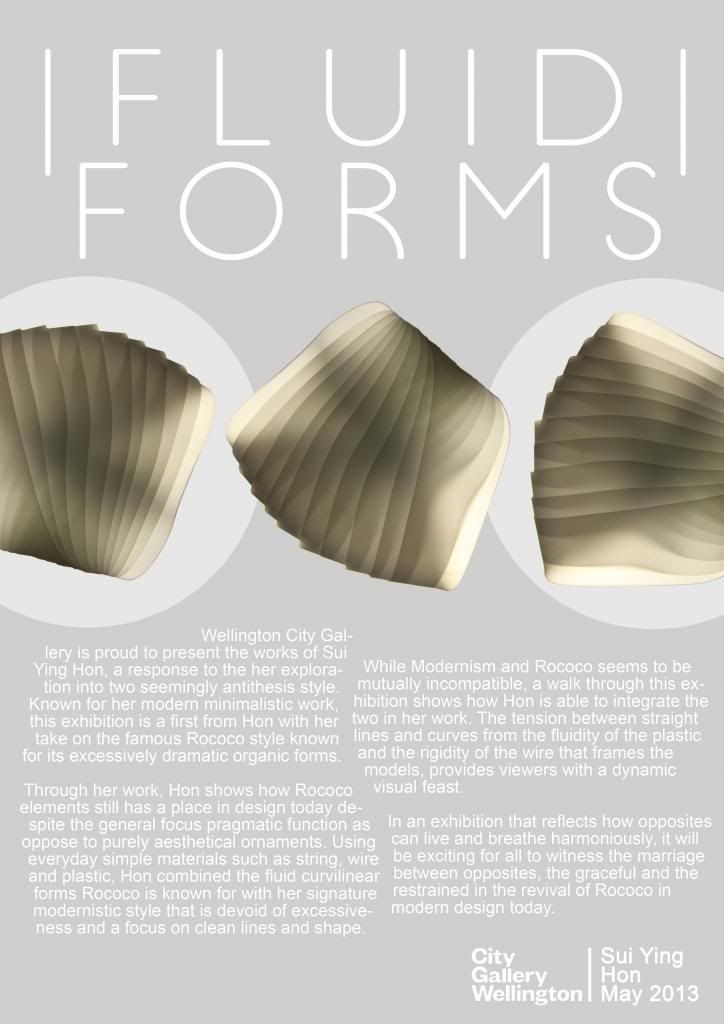
Wellington City Gallery is proud to present the works of Sui Ying Hon, a response to the her exploration into two seemingly antithesis style. Known for her modern minimalistic work, this exhibition is a first from Hon with her take on the famous Rococo style known for its excessively dramatic organic forms.
Through her work, Hon shows how Rococo elements still has a place in design today despite the general focus pragmatic function as oppose to purely aesthetical ornaments. Using everyday simple materials such as string, wire and plastic, Hon combined the fluid curvilinear forms Rococo is known for with her signature modernistic style that is devoid of excessiveness and a focus on clean lines and shape.
While Modernism and Rococo seems to be mutually incompatible, a walk through this exhibition shows how Hon is able to integrate the two in her work. The tension between straight lines and curves from the fluidity of the plastic and the rigidity of the wire that frames the models, provides viewers with a dynamic visual feast.
In an exhibition that reflects how opposites can live and breathe harmoniously, it will be exciting for all to witness the marriage between opposites, the graceful and the restrained in the revival of Rococo in modern design today.
Labels: dsdn171


Labels: dsdn171
Pt. 1 Relevance of a library in a design school
With the advent of the digital age, imformation is becoming more and more accessible to users anywhere. Technologies such as laptop, tablets and smartphones combined search engines like Google and online encyclopedias like Wikipedia allow users to easily get information on any subject matter which a click of the mouse or a swipe of the finger. Books are also envolving into the digital world with the influx of eBooks and online data. This thus seem to suggests the irrelevancy of libraries, the act of physically going into a library and pouring through books to look for specific information seems cumbersome and redundant.
However, it is precisely because of the widespread of information online that libraries are evermore important. With information flowing from every corner of the world, it is becoming hard to determine relevant and unbiased information online. Sites like Wikipedia can be edited by anyone, the lack of vetting when it comes of information online means that inaccurate and biased opinions can be put up and passed for the truth. The books in the library however have gone through a vigorous process of editing and reviews and are written by individuals who are experts in their field and thus knowledge gained is relevant and most importantly authoritative, allowing for successful research based on reliable information.
We must also not forget that as the world progress in the digital age, libraries, especially those found in university campuses are also keeping up with the growth of technology. For example, Victoria University of Wellington (VUW) library at Te Aro campus offers a wide range of services and material from loaning of equipment to facilitate research to inclusive and extensive databases allowing students to access to useful materials in the library both physically and virtually. This is especially useful for design students when it comes to their research as books in the libraries contain rich materials as compared to those online that can educate the students in historically important designers, for example, and at the same time be inspired by their words and work.
Lastly, this quote from the introduction from Robert Darnton's The Case for Books: Past, Present, and Future accurately summarizes the reason for the continued importance and relevancy of libraries: "And the library? It can look like the most archaic institution of all. Yet its past bodes well for its future, because libraries were never warehouses of books. They have always been and always will be centers of learning. Their central position in the world of learning makes them ideally suited to mediate between the printed and the digital modes of communication."
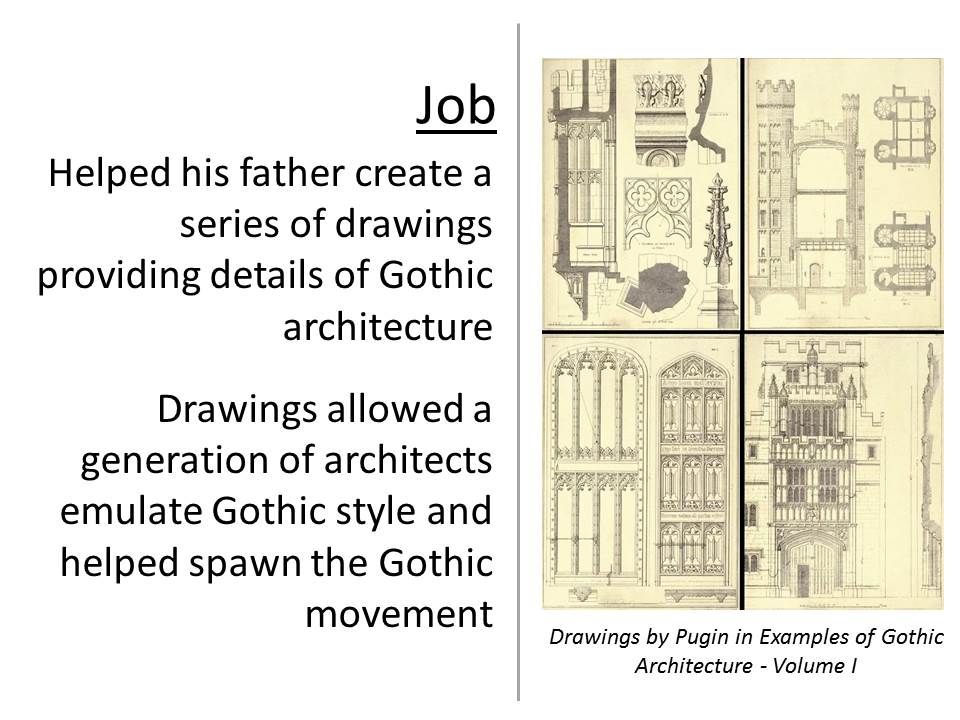
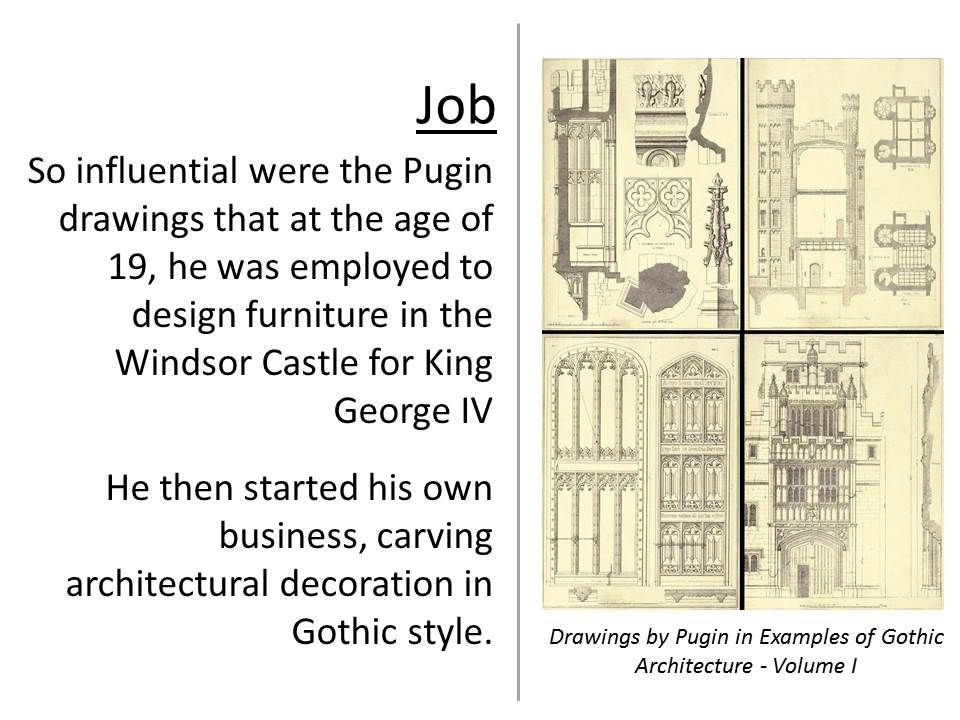
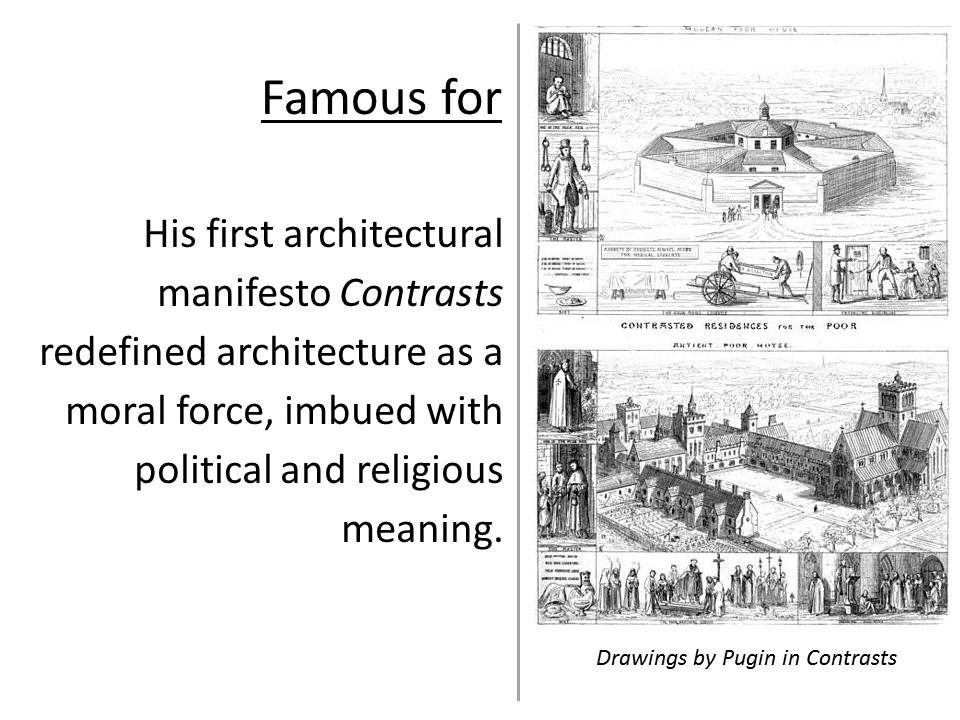
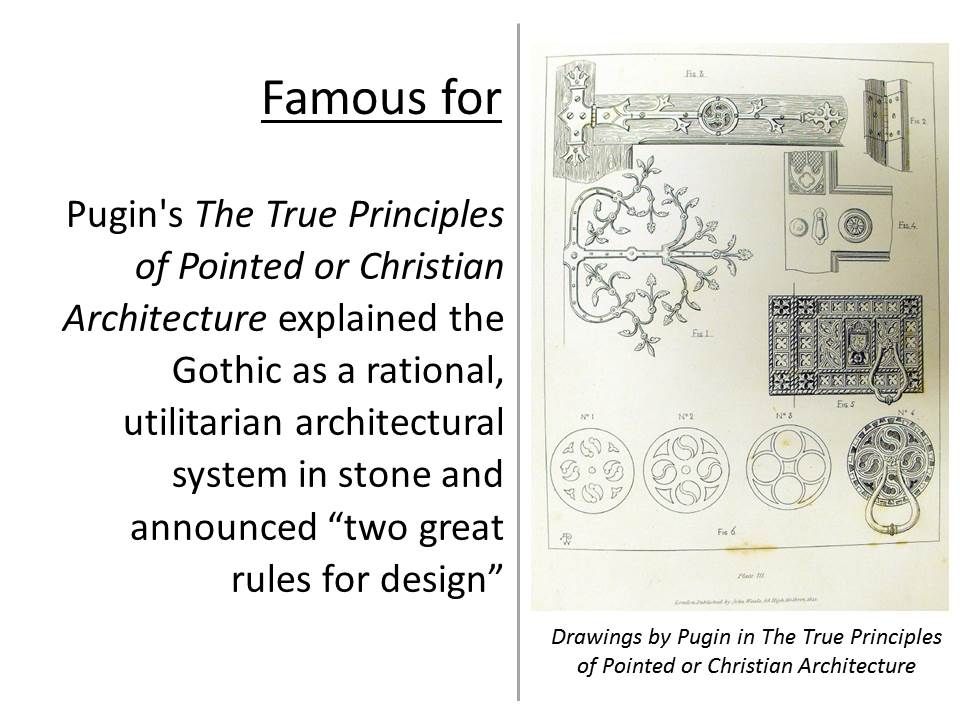
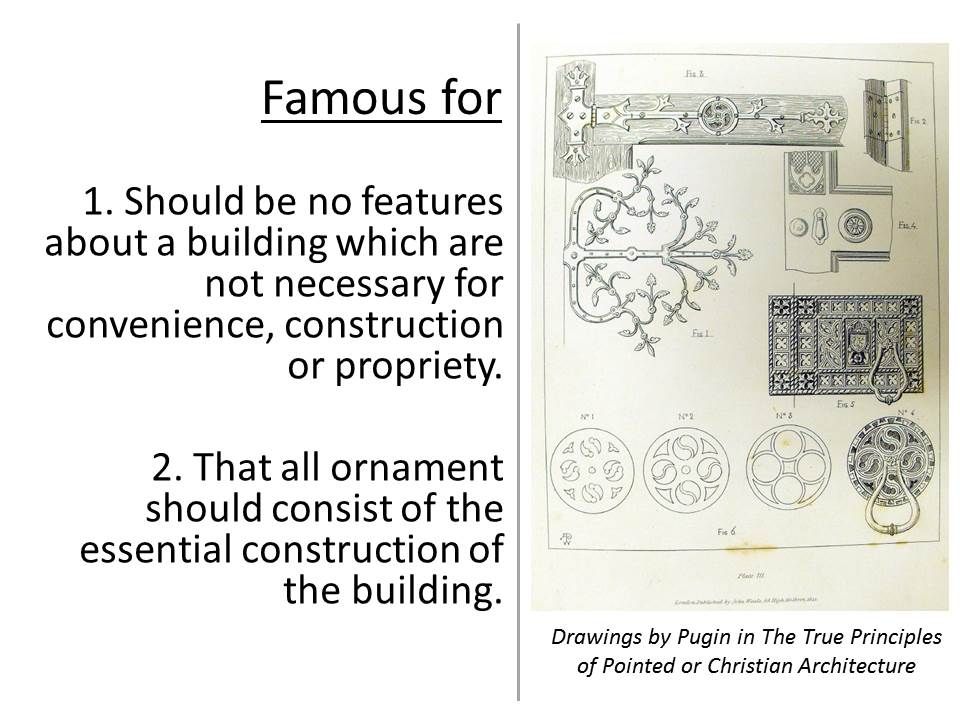
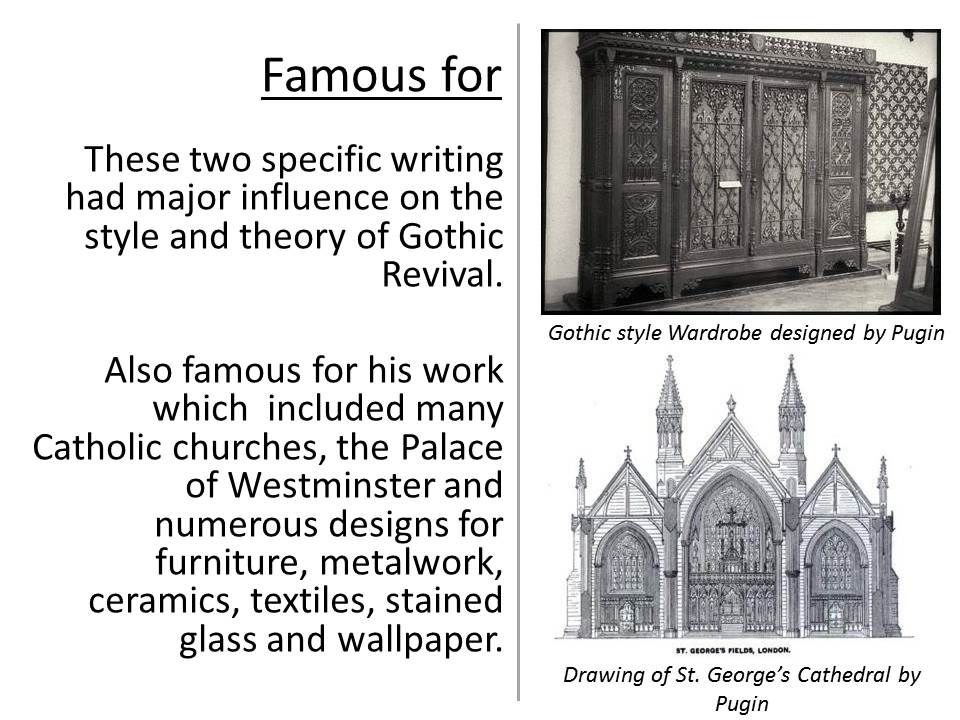
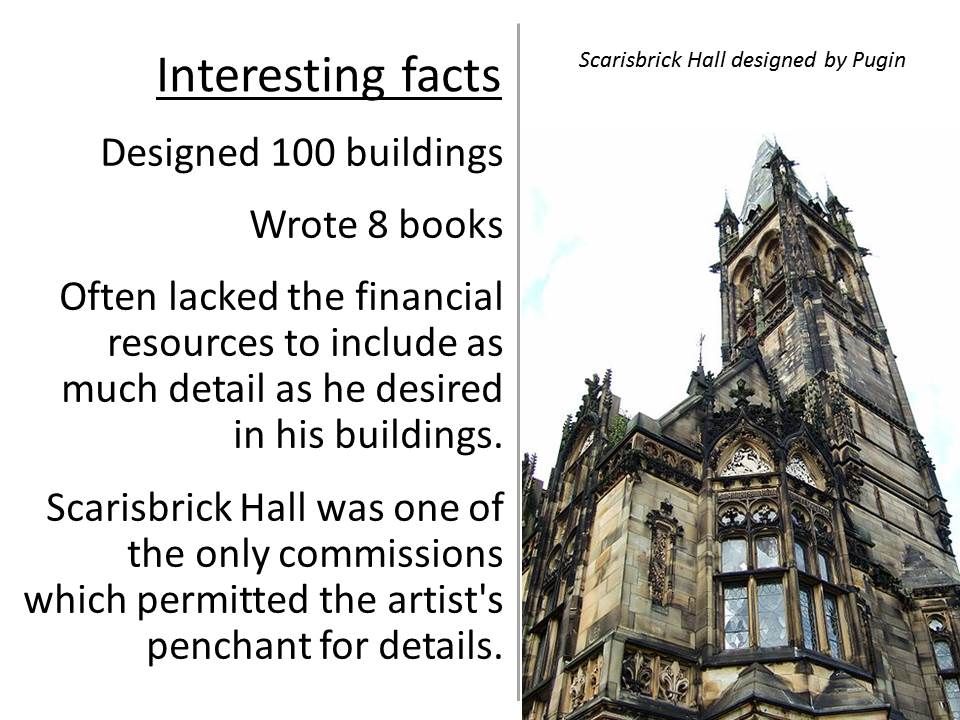
Pt. 2 Research theme: Augustus Welby Northmore Pugin
Powell, C. (2006). Augustus Welby Pugin, Designer of the British Houses of Parliament: the Victorian tuest for a liturgical architecture. Lewiston, NY: Edwin Mellen Press.
Curtis, W. (2012). Reputations: Augustus Pugin. The Architectural Review, 231(1383), 102-103.
Victoria and Albert Museum. (1994). Pugin: a Gothic passion. New Haven, CT: Yale University Press.
Hill, R. (2007). God's architect : Pugin and the building of romantic Britain. London, England: Allen Lane
Pt. 3 Images

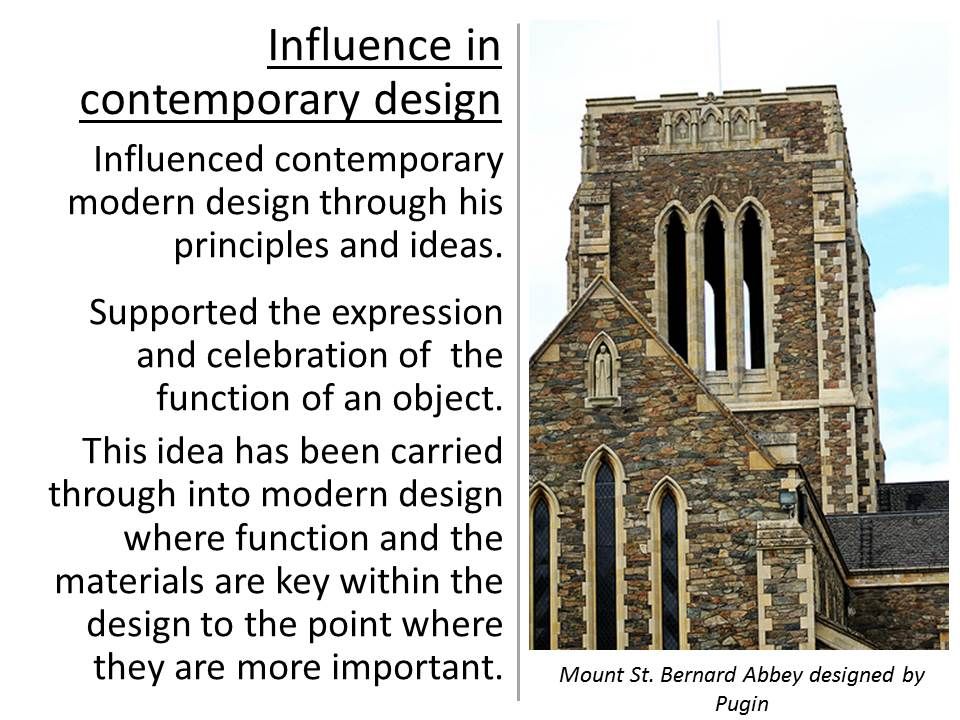
Pugin, A.W.N. (1848). Florentine Silver Dish [Metalwork]. Victoria and Albert Museum, London. Retrieved from Victoria and Albert Museum Online database.

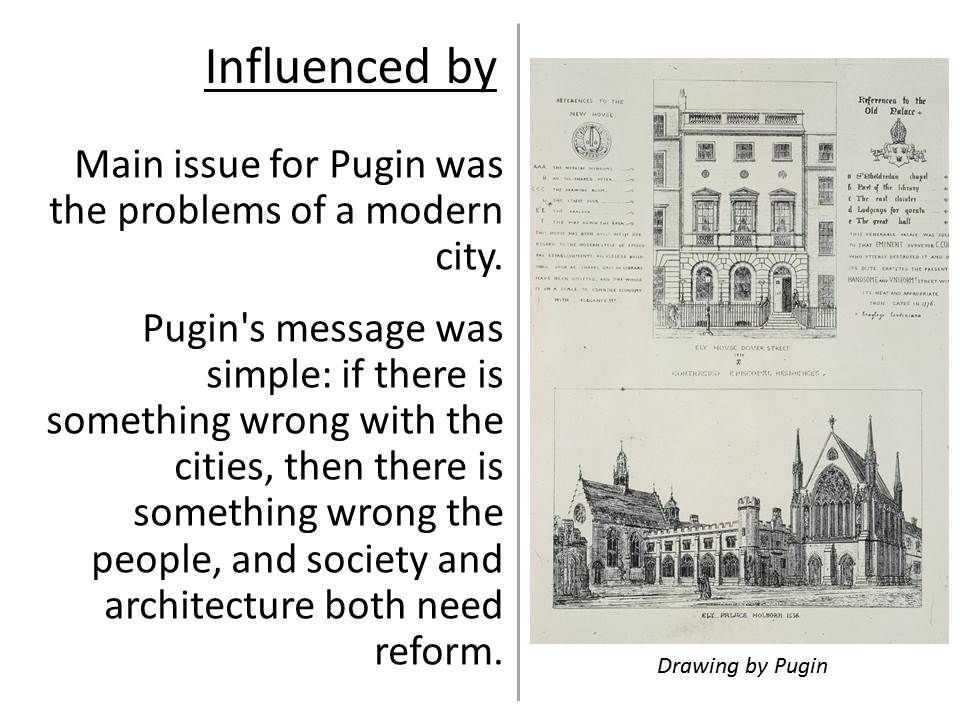
Pugin, A.W.N. (ca. 1812--1852). Contrasting view of Bishop's residence in 1536 & 1836 [Drawing]. Retrived from ARTstor Online database.
Labels: dsdn171, dsdn171.task1.handin
0 comments / + add comment